

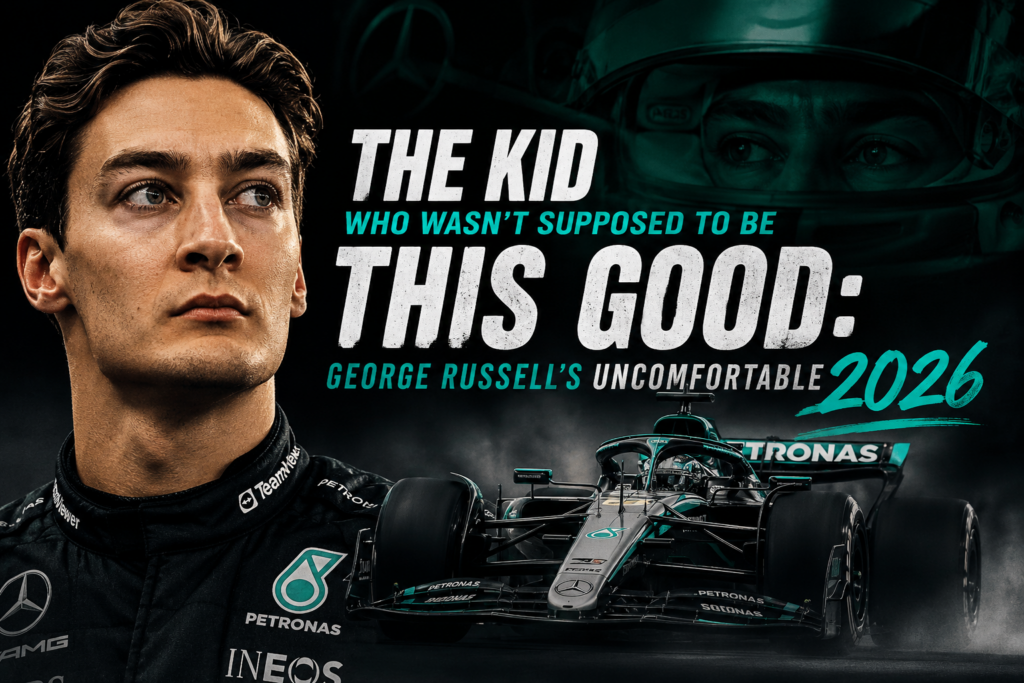
The Kid Who Wasn’t Supposed to Be This Good: George Russell’s Uncomfortable 2026
Jul
George Russell 2026 opened with him as Mercedes’ clear number one. Eight seasons into his F1 career, coming off a strong 2025, and paired with a teenager in only his second year, the hierarchy seemed settled. Nine rounds in, it isn’t. Kimi Antonelli, 19, leads Russell by 25 points in the drivers’ championship, has out-qualified him more often than not, and has generally been the faster Mercedes driver on a Sunday. Russell himself has stopped arguing otherwise.
That’s the striking part of this story. It isn’t journalists or Toto Wolff framing Antonelli as the quicker man this year — it’s Russell. After the British Grand Prix in early July, he was blunt: “He has done a better job than me this year to this point, so he deserves to be ahead of me.” Asked to put a number on the fair gap between them, he didn’t dodge: “Anywhere from 10 to 30 points behind is probably about fair.” For a driver who spent the early races attributing the deficit to bad luck, that’s a real shift in tone — from explaining away a gap to owning it.
George Russell 2026: What the Numbers Actually Show
The underlying pace data backs up the sense that this isn’t just misfortune evening out. Antonelli’s average qualifying delta to Russell has been around 0.054 seconds in his favor, and on several weekends — Miami and Monaco especially — the gap has widened to three or four tenths, convincingly in the rookie’s favor. Russell has had his moments: he beat Antonelli in both Montreal qualifying sessions, and mechanical misfortune has hit both of them, including matching engine failures. But take the sport’s own accounting of the situation, and it points in the same direction Russell now points himself.
Why it might be happening: a car built for someone else’s driving style
The most interesting explanation floating around the paddock isn’t about raw ability — it’s about fit. Russell has long driven in a smooth, high-commitment style: brake early, stabilize the car, carry momentum, let the mid-corner take care of itself. It’s a style that worked beautifully with the previous generation of ground-effect cars, rewarding a driver who could load the tire progressively and trust the platform.
The 2026 regulations, with markedly reduced downforce, have apparently punished exactly that approach. Lower grip means more of what’s called “microslides” — small, constant movements of the car that a driver has to correct for continuously, rather than a single committed input at turn-in.
Antonelli’s driving style, by contrast, is built on plentiful but subtle corrections: he’s comfortable committing to a corner without being fully certain of the grip, and adjusts on the fly. That happens to be precisely the skill set low-downforce, lower-grip 2026 cars reward. Russell has effectively confirmed this himself, saying “the difference is how we’re driving has such an impact on the tyres,” and admitting there’s “something in my driving style that’s not helping the car at the moment.”
There’s also a straight-line speed problem that has nothing to do with driving style. Wolff has acknowledged Mercedes can’t fully explain a deficit specific to Russell’s car, saying the team has “left no stone unturned” trying to find it, which suggests part of this isn’t a Russell problem so much as a car-and-driver-interaction problem that happens to show up more on his side of the garage.
The psychological subplot
None of this is happening in a vacuum for George Russell in 2026. Russell has openly said he’s “still struggling to understand this car,” a remarkable admission from a driver in his eighth F1 season.
There’s also been friction with Lewis Hamilton, now at Ferrari and sitting just seven points back — a reminder that Russell isn’t only fighting his own teammate, he’s fighting a former teammate too, with all the extra scrutiny that invites. And Antonelli hasn’t been immune to trouble either: a Barcelona engine failure while running second, and a broken wheel-guard cost him a likely win at Silverstone. So it’s not as though the rookie is cruising to the title unchallenged — Russell has actually clawed back points recently, closing a 68-point gap after Monaco was down to 25 by mid-July.
What this says about Antonelli, not just Russell
It’s tempting to read this purely as a story of Russell’s decline or discomfort, but the more generous — and probably more accurate — reading is that Antonelli is simply arriving as advertised. His rookie year was solid but unspectacular, partly because a since-abandoned rear suspension development direction cost the team months of progress. Strip that out and project the trajectory forward, and a driver who’s faster, more adaptable to low-grip conditions, and mentally unbothered by racing his senior teammate for a championship starts to look less like a surprise and more like Mercedes simply having found their next star slightly ahead of schedule.
Where it leaves Russell
George Russell’s own conclusion is the most honest anyone involved has offered: he needs to be better, not luckier. Whether the smooth, patient style that defined his rise can be adapted to reward the tires the way this car demands is the open question of Mercedes’ season — and, increasingly, of Russell’s long-term standing in an operation that now has two title-capable drivers instead of one.
