

F1 Street Circuits Aren’t a Gimmick. They’re the Business Model.
Jul
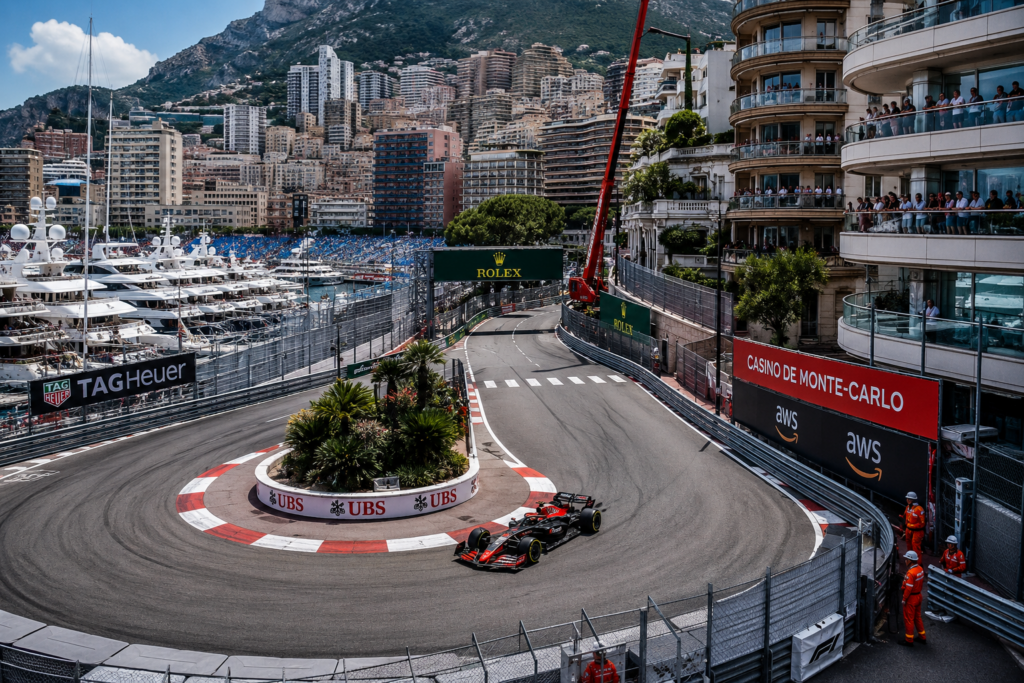
F1 street circuits are routinely dismissed as gimmicks. Within an hour of a new city race being announced, the timeline produces the groan, the obligatory lap of Spa, the parking-lot jibe, and the word “gimmick” doing more work than it can carry.
I understand the instinct. I think it’s wrong—and increasingly, the evidence is on the other side.
F1 street circuits are part of the sport’s history
Start with the history, because the traditionalist case leans on it, and it doesn’t hold. The first World Championship season in 1950 included Monaco, a street circuit, and Bremgarten, a forest road course. Pau, Long Beach, Detroit, Adelaide, Dallas and Phoenix: the sport has been running between buildings for as long as it has been running. The Nürburgring Nordschleife, the most romanticized track in the sport’s history, was a public road.
What is actually traditional in Formula 1 is racing on infrastructure that already exists, in places where people already are. The sterile, FIA Grade 1, 200-acre facility with acres of asphalt runoff and a permanent grandstand that fills four days a year is a modern invention. It is a product of the 1990s and 2000s, and it is what made half the calendar feel interchangeable.
The economics of street racing work
Here is the unglamorous truth about permanent circuits: most of them are terrible businesses. A Grand Prix venue costs hundreds of millions to build and then needs a full calendar of club days, testing, track days and support series to stay solvent. A meaningful number of purpose-built F1 tracks have needed government money to survive, and several have quietly fallen off the calendar when that money stopped.
An F1 street circuit inverts the problem. The tarmac is already in place and maintained. The hotels, restaurants, airports and transit already exist. The capital cost is barriers, grandstands, resurfacing and a lot of logistics—real money, but a fraction of building from scratch. It also does not leave a concrete carcass behind when the contract ends.
Meanwhile, the host city captures the tourism revenue directly. That is why cities are willing to co-fund an event in a way that a promoter forty miles into farmland never can. If you want a 24-race calendar that is not underwritten entirely by state actors, F1 street circuits are not an aesthetic preference. They are the financing model.
City races bring Formula 1 to the audience
Formula 1’s growth story over the last five years is not subtle, and it is disproportionately urban. The 2025 season drew a record 6.7 million fans across the year. The first half of 2026 sold out every race weekend, with attendance up six percent year on year. Miami, Las Vegas, Jeddah and Singapore did not cannibalize that growth. They helped create it by putting the sport in front of people who would never have driven three hours to a countryside circuit on a Sunday.
This matters beyond ticket sales because F1 street circuits turn the host city itself into the venue. You cannot ignore a race in a city center. Roads close, bars fill and the skyline gets rearranged for a week. People who have never watched a Grand Prix end up with a view on it anyway. That is a reach no rural circuit will ever buy.
Madrid’s arrival in 2026 with the Madring is the clearest statement of intent yet: a Grand Prix in a European capital, beside a convention complex and deliberately reachable on the metro. That is the shape a race weekend should have. See where it sits on the full 2026 F1 race schedule.
The sporting argument is better than critics admit
Now the real objection: street circuits produce boring races. Monaco is the exhibit, and Monaco is genuinely indefensible as a race in 2026.
But Monaco is an outlier, not a category. It is a circuit designed for cars that were half the size, never widened and preserved for reasons unrelated to racing quality. Judging every city course by Monaco is like judging all road circuits by one aero-washout problem. You are indicting one bad example, not the concept. Our Circuit de Monaco guide explains why its history and its modern racing limitations now sit so uneasily together.
What modern F1 street circuits deliver
Jeddah is the second-fastest circuit on the calendar and routinely produces genuine wheel-to-wheel racing. Baku pairs a two-kilometer straight with a castle section barely wider than a car, which is why it delivers chaos almost annually. Singapore is a brutal, attritional endurance test that has repeatedly turned championships upside down. Las Vegas produced hard racing at 210 mph down the Strip.
At F1 street circuits, the walls change driver behavior in a way runoff never will. On a modern permanent circuit, a mistake costs a driver two-tenths and a flat spot on the tires. On a city circuit, it might cost them the car. That asymmetry restores something the sport has been quietly losing for twenty years: consequence.
It rewards the drivers who can carry commitment with no margin and punishes the ones who cannot—which is exactly the sorting mechanism a drivers’ championship is meant to have. If you want to see the most dramatic version of that bargain, read the Baku City Circuit guide.
F1 street circuits also inject variance into a sport that badly needs it: safety cars, red flags, unpredictable grip evolution and one-lap qualifying that can actually decide the race. In an era when one team can dominate for years at a stretch, a calendar with more high-variance events means more races worth watching in August.
How Formula 1 should design better city circuits
None of this is a defense of bad street circuits, and F1 has built its share. The lesson from Valencia and Sochi is not that cities are bad. It is that you cannot draw ninety-degree corners around an office park, add a wide braking zone and expect racing.
The basic ingredients are clear:
- Give drivers one long, flat-out section into a heavy braking zone.
- Use elevation wherever the city provides it.
- Keep the tight sections genuinely tight, so mistakes carry a cost.
- Lay a surface that evolves over a stint.
- Make public transport part of the event plan from day one.
Jeddah, Baku and Las Vegas all manage much of this. Madrid, with a twenty-percent drop through the Cerro section, is clearly trying to. The official Formula 1 calendar shows just how central city events have become to the modern championship.
Street racing is the business model—not a gimmick
Formula 1 should keep Spa, Suzuka, Monza and Silverstone forever. They are the sport’s cathedrals, and no calendar can work without them. But the marginal new race should be a street race.
It is cheaper, it reaches more people, it puts consequence back into driving, and it takes the sport to the places that want it instead of asking the audience to make a pilgrimage.
Build the race where the city is. Everyone wins except the people posting Spa onboards.
