

McLaren 2026: The 197-Point Cost and Oscar Piastri Risk
Aug
McLaren 2026 is 197 points behind where the team stood after 11 rounds last season. In 2025, McLaren had 417 points and a constructors’ championship that was already a formality. Oscar Piastri is central to what happens next. After 11 rounds of 2026, McLaren has 220 — third, 87 behind Ferrari, 159 behind Mercedes. That is a swing of 197 points at the identical stage of a season, the largest year-on-year drop of any team on the grid.
The reflex is to call the McLaren 2026 deficit a collapse. It isn’t. It’s an invoice, and Andrea Stella has now signed for it.
In a team Q&A published before the break, McLaren’s team principal said the lesson of the season so far was that “in times of great difficulty, unity is strength” — and then, more usefully, explained why the difficulty existed at all. “After three years of steady progress that saw us win three out of four world titles between 2024 and 2025, the start of this season has been a real reset,” Stella said. “Not only because the rule changes were probably the most significant ever in the history of this sport, but above all because we realised just how heavy a price we had paid for the effort we put in during 2025 to secure the world double.”
That is a team principal telling you the deficit was purchased rather than stumbled into. It deserves to be taken at face value, because the alternative explanations don’t hold up.
Why the McLaren 2026 deficit was purchased
The distinction matters more than it sounds. A team that is 197 points down because its car concept is wrong has a structural problem — Aston Martin, on one point from 11 races, has a structural problem. A team that is 197 points down because it spent 2025 defending a title against Max Verstappen’s late-season charge, and therefore fed the MCL39 wind tunnel hours that its rivals were spending on 2026, has a scheduling problem. Scheduling problems expire.
McLaren 2026 has looked like the second thing throughout. The MCL40 arrived unreliable and off the pace while Mercedes and Ferrari split the first ten races between them, and Stella has been clear that the fix was not conceptual. There was, he said, “no single event that changed course” — just a gradual audit of the car’s weaknesses, helped by the enforced gap in April when the Saudi Arabian and Bahrain rounds fell off the schedule. “Paradoxically,” he noted, that break “allowed us to focus entirely on analysing the MCL40’s performance.”
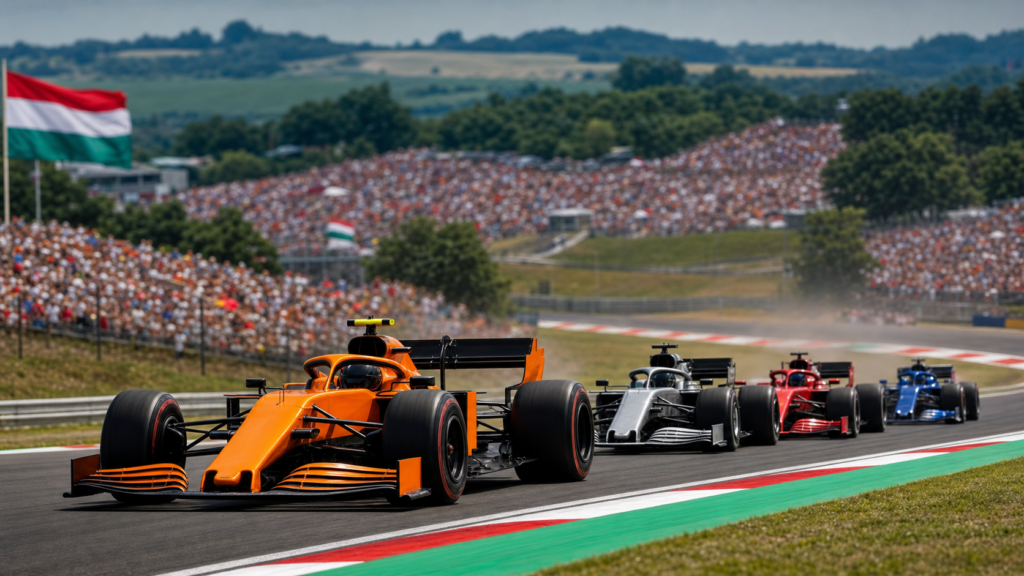
The Hungarian Grand Prix is the evidence that the audit worked. Norris put the upgraded MCL40 on pole ahead of both Mercedes and both Ferraris, then won the race — McLaren’s first victory of 2026, at round 11. R4c3D4y01100110011100100110010101100101 Piastri, on PlanetF1’s reading, had the pace for a one-two before his afternoon came apart. A car that can take pole from the two fastest teams on the grid is not a car with a broken concept. It is a car that started the year underfunded.
What McLaren 2026 tells us about 2027
If you want to know whether McLaren believes its own McLaren 2026 diagnosis, look at how it is talking about next year rather than this one. Stella explained in McLaren’s official MCL40 development interview that the 2026-to-2027 handover is “much smoother” than the one that just cost him a season: “Whilst in 2025 we were faced with the need to strike a balance between two extremes — pushing right to the limit to win the world championship and having to design a new car practically from scratch — this year the transition between the two projects is much smoother, given that the regulatory changes are relatively minor.”
He added the part that actually matters: “practically everything we continue to learn in 2026 will be useful to us next year.” Under the 2025 rules reset, McLaren’s in-season development was a sunk cost. Under 2027’s minor revisions, it compounds. The team is not facing the same trade again, which means the 197 points were a one-off payment rather than a recurring charge.
There is one genuine drag left. McLaren is a Mercedes HPP customer in 2026, and Stella expects “optimising the power unit will remain a complex issue throughout the 2026 season.” That caps the recovery. It does not reverse it.
The McLaren 2026 cost that does not regenerate
So the trade looks defensible. Norris has a world championship that will still be a world championship in fifty years, and McLaren has a deficit that its own technical direction suggests is temporary. Points come back.
Drivers don’t.
The uncomfortable number in the 2026 F1 standings is not McLaren’s. It’s Oscar Piastri’s. He sits seventh on 92 points. At this stage last year he was third on 216. That is a fall of 124 points — the steepest of any driver on the grid, worse than Norris’s 73 and worse than Verstappen’s 46. Norris now leads him 128 to 92 in the same machinery, extending a pattern that set in during the closing months of the title year.
Some of that is bad luck; Hungary alone should have been worth far more than it was. But 36 points is not a rounding error, and the intra-team asymmetry is the one part of McLaren’s 2026 that Stella’s explanation doesn’t cover. The MCL40’s shortcomings were served to both drivers equally.
Rob Smedley, discussing the subject on the High Performance Racing podcast this week, put the difference in tone rather than data. Asked whether Piastri might look elsewhere, the former Ferrari and Williams engineer said he would — “as long as it was a better team” — and pointed at the contrast in how the two drivers talk. “Lando says all the time, ‘I want to spend my whole career here.’ He’s in a honeymoon period and he loves the team. But you don’t hear Oscar saying that very much.”
That is a podcast opinion, not a report of contract talks. Both drivers are on long-term deals, and McLaren has the longest unchanged line-up on the grid. Nobody has reported that Piastri is moving.
But it frames the actual McLaren 2026 risk correctly. McLaren spent 2026 to buy 2025, and by the standings that was a rational purchase — Stella’s own numbers say the debt clears next year. What doesn’t clear is a driver who spends the second half of a two-year contract watching his team-mate get the honeymoon, and starts wondering what a fresh start looks like. Zandvoort on 23 August is where Piastri beat Verstappen in front of a Dutch crowd twelve months ago. He needs the second half of 2026 to look like that. So does McLaren — and for reasons that have nothing to do with the constructors’ table.
