
A World Cup Pushed IndyCar Out of Downtown Toronto. Markham Is the Better Racetrack.
Aug
The IndyCar Markham era begins when the Ontario Honda Dealers IndyCar race runs this Sunday 23 miles northeast of where it has been staged since 1986, and IndyCar did not choose that. Exhibition Place became unavailable because of the logistical demands of the 2026 FIFA World Cup, and the series went looking for somewhere else to race in Ontario. It should send a thank-you note.
The IndyCar Markham circuit is not a compromise venue. On the numbers, it is a straightforward upgrade over the circuit IndyCar spent four decades on, and the reason has less to do with civic ambition than with a railway line.
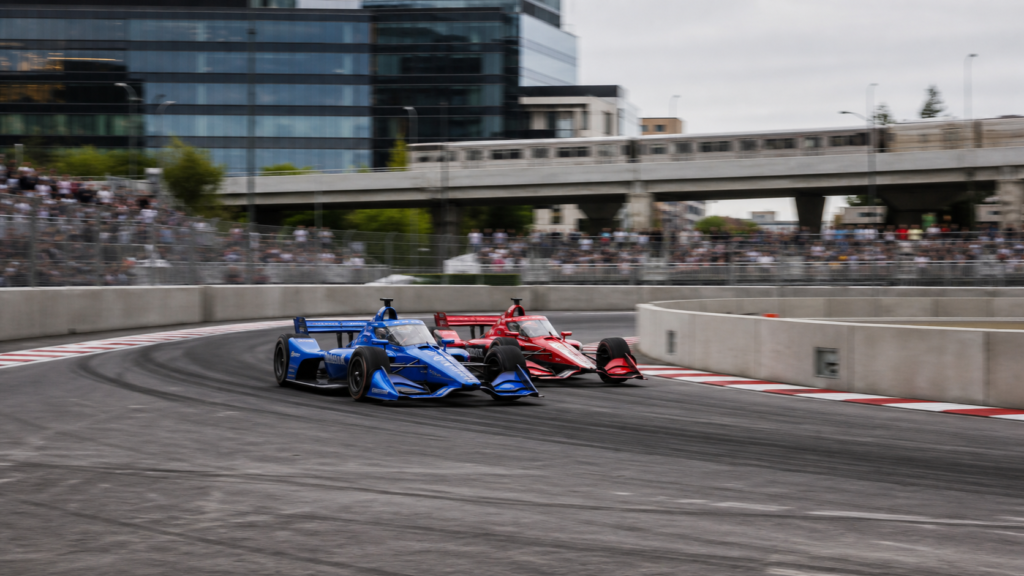
Exhibition Place was 11 turns and 1.786 miles. The new Markham Center layout, designed by Tony Cotman of NZR Consulting, is 12 turns and 2.19 miles — 3.52 km. Sunday’s race is 90 laps, which comes to a shade over 197 miles. That extra four-tenths of a mile per lap sounds like a rounding error until you remember what IndyCar is trying to fit inside it: 25 full-time cars, 24 of which were covered by 1.4 seconds in qualifying at the last new street circuit the series visited.
The pit lane is the whole argument
The Unionville GO line runs straight through the eastern precinct of downtown Markham. Cars will pass beneath it between Turns 4 and 5 and again on the exit of Turn 5. A conventional design would have routed around that constraint and lost track in the process. Cotman’s design used it, and the consequence is a double-sided pit lane — the same solution Detroit has run since 2023 and the one Arlington debuted in March.
“We’re excited to have a double-sided pit lane,” Green Savoree Racing Promotions president Kevin Savoree said when the layout was unveiled last September. “It’s becoming something iconic in INDYCAR.”
Iconic is generous. Necessary is closer. A single-sided pit lane on a narrow street grid is where street races most reliably go wrong — stacked stops, blocked lanes, and a pit exit that settles the running order before the field reaches Turn 1. Three of IndyCar’s newest street circuits have quietly designed that problem out. That is a series learning something, not a series improvising.
The rest of the IndyCar Markham layout follows the same logic. The Turn 5 hairpin is built wide enough to hold more than one line and feeds a long run down Enterprise Boulevard where the cars are expected to exceed 180 mph before the right-hand Turn 6. There is a second passing window between Turns 8 and 10. A slow, wide corner onto a long straight is the most dependable overtaking recipe in the sport, and it is the thing Exhibition Place never really had.
Why IndyCar Markham can follow Arlington’s lead
The counter-argument to new street circuits is that they take three or four years to produce a race worth watching. Arlington disproved it in one afternoon on March 15.
Kyle Kirkwood beat Alex Palou by 0.3140s over 70 laps on a 2.73-mile temporary circuit nobody had ever driven competitively. Will Power was third, 3.5855s back. Five drivers led. Twenty of the 25 starters finished on the lead lap, and only three cars failed to see the finish. Kirkwood started seventh. Christian Lundgaard came from 18th to seventh, Scott Dixon from 20th to eighth, and Scott McLaughlin, who qualified 25th and last, finished 11th.
For official series coverage, visit INDYCAR. That is not what a first-year street circuit is supposed to look like. It is strong evidence that IndyCar Markham can deliver on its first attempt. It is what a properly designed one looks like, and it is the strongest available evidence that Markham’s drawing will translate.
What Toronto was actually worth
The sentimental case for Exhibition Place is real and should not be waved away. Forty years of results is equity: Dixon won there four times, Power and Josef Newgarden twice each, Lundgaard and Pato O’Ward once apiece, with O’Ward taking the final running last year. Downtown Toronto is a better postcard than a suburban office district, and the series has surrendered a venue whose name meant something to a generation of Canadian fans.
But listen to the promoter. Jeff Atkinson, who runs the event, said flatly that Exhibition Place had maxed out its available space and that Markham “provides new sight lines and experiences we just couldn’t offer at the old site.” Promoters do not usually volunteer that their previous home was full. Kevin Savoree added that they “literally explored sites all over Ontario” before settling here, which is not the language of a team that got shoved out the door and grabbed the nearest parking lot.
There is an audience argument underneath it too. FOX’s first season of IndyCar coverage produced an 81 percent increase in viewers aged 18-34 and a 72 percent rise in women within that bracket. Markham Center — corporate headquarters, York University’s Markham campus, the Pan Am Center, GO and VIVA transit, Highway 407 on the doorstep — is where a series chasing that demographic goes looking for it. Exhibition Place was not.
The IndyCar Markham gate is the real test
None of the circuit design matters if the crowd doesn’t follow. IndyCar Markham organizers are projecting more than 140,000 across the three days, which would make it the largest sports and cultural event in York Region’s history. Two-day tickets started at $90 including tax, and all four grandstands — pit lane, Turn 3, the Remington-backed Turn 5 hairpin and Turn 8 — sit on braking zones rather than on scenery. The pricing and the seat placement tell you what the promoter thinks its job is this weekend: carrying an existing audience 23 miles up the highway rather than conjuring a new one.
The IndyCar Markham deal is multi-year, so there is time to get that right, and the second edition will be harder than the first: the IR-28 arrives in 2027, meaning year two pairs a still-green surface with a car the teams will barely understand. Alexander Rossi only completed the first validation run at Indianapolis on August 1.
Browse our latest motorsport coverage for the wider championship context. The championship is not what’s at stake here. Palou leads Kirkwood 510 to 400 after 13 rounds, has won three of the season’s four street races and needs no favors from a new venue. IndyCar Markham is a test of something the series has been worse at than it should be for twenty years: building a race from nothing and having it work on the first attempt. On the evidence of the layout and of what Arlington produced in March, IndyCar has finally figured out how. It just took a soccer tournament to make it try.
