

Everything Working Against the Madring: F1’s Newest Circuit Has a Difficult Weekend Ahead
Sep
Filed under: Formula 1 · Analysis
Formula 1 arrives in the Spanish capital this weekend for the first time in more than four decades, and it does so at a venue that has spent the last twelve months collecting problems the way most new circuits collect press releases. The Madring — the 5.416km hybrid street-and-purpose-built layout wrapped around the IFEMA exhibition complex north-east of Madrid — hosts its inaugural Grand Prix on 11–13 September. On paper it is one of the most ambitious circuit projects F1 has taken on this decade. In practice, the run-up has been a steady drumbeat of red flags, lawsuits, decibel readings, stolen cable and pointed driver commentary.
Here is what the paddock is actually walking into.
The layout is the problem, and it’s also the point.
Start with the track itself, because almost everything else radiates outward from it.
The Madring is 22 corners long (23 and 24 if you count the 5A and 20A variants) and contains almost nothing that a driver would recognize as a rest. Sky Sports’ preview described a lap requiring near-constant steering input, with a qualifying time expected to land somewhere around the 90-second mark. Lewis Hamilton, after early running on the surface, put it plainly: there are “not really any straights. So it looks like a difficult place to overtake.”
That is a specific kind of problem. Modern F1 circuits are usually criticized for being too easy — too much run-off, too little consequence. The Madring’s issue is the inverse. It is a layout that punishes error severely while offering limited reward for aggression, which is the exact combination that produces processions punctuated by safety cars rather than genuine racing.
The M-11 motorway splits the circuit, and two tunnels connect it. The southern portion threads through existing IFEMA infrastructure and behaves like a conventional street circuit — tight, walled, unforgiving. The northern section is newly built and considerably more open. The Madring’s two halves ask different things of the car, and setting up for both is the weekend’s first real headache.
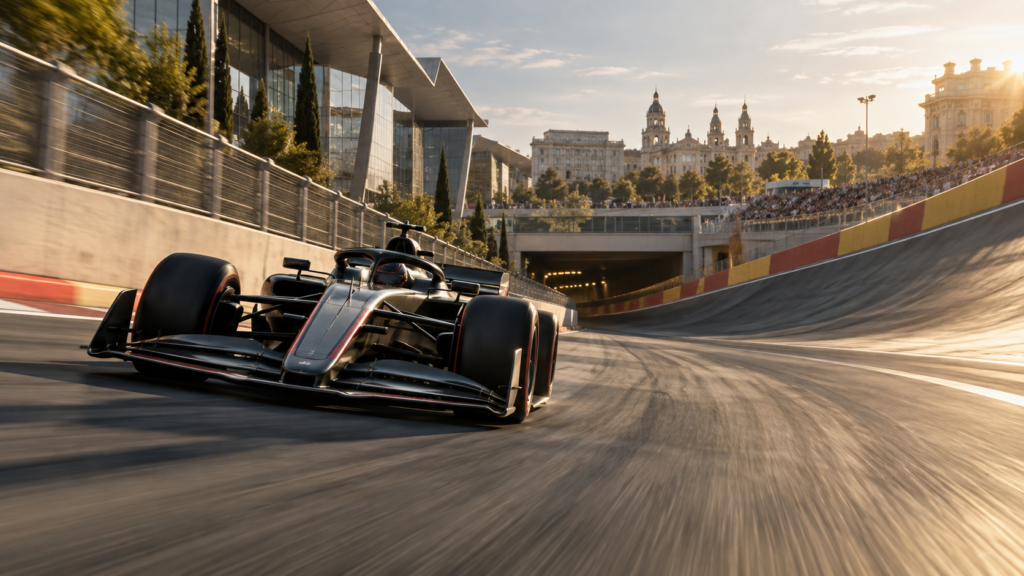
The signature feature, La Monumental at Turn 12, is genuinely impressive engineering: a 550-meter banked right-hander climbing roughly 10 meters at a 24 percent gradient, about 13.5 degrees of bank. Carlos Sainz expects it to be flat at 180–200 km/h, generating more than 4G. Charles Leclerc has said it will take a “very brave” driver to commit to it fully in qualifying and reckons it could become “one of the most iconic corners” in the sport.
Worth noting: the Madring banking was deliberately capped at 13.5 degrees. The original design ambitions were steeper, and the angle was pulled back over legitimate concerns about tire failure under sustained lateral load. That reminds us this corner sits close to the edge of what current F1 rubber tolerates, not comfortably inside it.
Nineteen red flags in two days
The clearest warning came from the Formula 3 in-season test held at the circuit in early September. Across two days, the session was stopped 19 times. Ten different drivers made contact with the barriers. Eleven stoppages were outright barrier hits; the rest came from spins, mechanical failures and debris.
That is not a normal number. That number makes race control nervous.
The Madring danger zones the test identified are worth cataloging, because they are the corners that will decide this weekend:
Turn 17 produced the most concern. It sits within a “staircase” sequence of consecutive 90-degree corners, walls tight on both entry and exit, with the exit running through a tunnel. Drivers repeatedly over-committed to the brakes into the middle of the corner. Two of the first day’s five red flags came from this corner alone.
Turns 5–6 form a tight left-right-left chicane that multiple observers have compared to the old Singapore Sling — a corner F1 eventually deleted because it was, by consensus, badly conceived. Aggressive curbs dominate the sequence. Sky’s analysis flagged Turn 5 as a place where two cars cannot run side by side, making it both an overtaking flashpoint and a first-lap liability.
Turn 7 is a blind crest that requires a driver to run wide left on entry to open up a right-hand apex, with a wall waiting on the exit before the track sweeps left again. Unlike the chicane — where drivers might sensibly take the run-off in a race — Turn 7 is problematic in every session type.
Turns 3, 10, 11 and 14 each contributed their own incidents, largely attributable to low grip.
Sainz has compared the character of the place to “Jeddah, Baku, even Macau,” and warned it will be “quite an interesting challenge.” F3 driver Bruno del Pino called it “the most adrenaline-fuelled circuit of the entire season.” Both are compliments. Both are also warnings.
The structural issue is this: a circuit where slight line deviations translate into high-speed barrier impacts, combined with limited space for recovery vehicles, is a circuit where crashes become red flags rather than yellow flags. That distinction matters enormously for a 305-kilometer Grand Prix. A single significant shunt in the wrong sector can rewrite the entire race.
A green surface with no grip and no rain to clean it
Madring track evolution will be extreme, and the weekend’s weather forecast does nothing to help.
Madrid is expected to be bone dry across all three days: roughly 23°C on Friday morning, rising to 30°C by FP2; a peak of 31°C on Saturday for qualifying; and 32°C for Sunday’s race. Rain risk sits at zero percent for the entire weekend.
That sounds like a clean run. It isn’t. It means the surface will be green and dusty from Friday morning, with no rain to wash it—only rubber laid down session by session. Hamilton already noted that the surface was dusty and low on grip during early running. Construction dust and strong winds were cited as contributing factors to the F3 crash-fest.
The practical consequence at the Madring is a moving target. FP1 will bear little resemblance to FP3, and Saturday’s qualifying grip level will be meaningfully different again from Sunday’s race conditions. On a circuit with walls this close, guessing wrong about where the grip has gone is how a driver ends up in the barriers at Turn 17. Teams that read the evolution correctly will look like heroes; teams that don’t will spend Sunday explaining themselves.
Pirelli has gone conservative in response, nominating the C2, C3 and C4 compounds — the middle of its range. The Italian manufacturer assesses that “the loads acting on the tires are comparable to those seen at circuits such as Silverstone and Spa-Francorchamps,” which is not what you would expect from a layout that looks, on a map, like a street circuit. La Monumental is doing a great deal of that work. The compound choice is intended to encourage a two-stop strategy and to guard against excessive overheating.
Translation: Pirelli does not entirely know what this track will do to its tires either, and has picked accordingly.
The 2026 cars add a variable nobody has data for
This is the first Madrid Grand Prix, and it is happening in the first season of a completely new technical formula. Those two unknowns multiply rather than add.
The 2026 power units place a far greater emphasis on energy deployment and recovery, and circuit layout now dictates energy strategy in a way it never did under the previous regulations. Analysis of the Madring suggests the design is actually reasonably well suited to this: the medium-speed chicane preceding La Monumental gives cars a window to recharge before the high-load banked section, which should help avoid the severe “clipping” — running out of deployable energy mid-straight — that has embarrassed teams at other venues this year.
That’s the theory. Nobody has race-distance data to confirm it. Every team arrives with simulation numbers and nothing else, and the first genuinely representative laps of the weekend will be run on a green surface in FP1 on Friday afternoon.
For a championship still mathematically alive, that’s a lot of variance to accept. Kimi Antonelli leads the Drivers’ standings on 267 points after his Monza win, 66 clear of Mercedes teammate George Russell on 201, with Lewis Hamilton third for Ferrari on 191 and Lando Norris fourth on 171. Mercedes leads the Constructors’ championship on 468 from Ferrari’s 346. A red-flag-heavy, safety-car-strewn race at an unknown venue is exactly the sort of event that redistributes points unpredictably — good news for anyone chasing, less so for Mercedes.
Off the track: lawsuits, decibels and stolen cable
The circuit’s difficulties are not confined to the racing surface.
The €83.2 million construction project, built by Acciona and Eiffage, ran a tight schedule that drew scrutiny for most of the year. Asphalt was still going down in May. Circuit manager García Abad has been firm that the work was “finished at the end of May, as stipulated in the contract,” and regional president Isabel Díaz Ayuso has publicly stated the circuit was completed on time. Reports through August nonetheless described construction still visibly in progress, with temporary structures and grandstands going up close to the deadline.
Then there is the residents’ campaign. Stop F1 Madrid has organized against the event on noise, traffic and environmental grounds, and has pursued the matter through the courts — a Madrid court rejected a request to suspend grandstand licenses in August. The group recorded an average of 102.7 decibels and a peak of 109.1 during the F3 running, figures the city notes were campaigner measurements rather than official surveys. Madrid councilor Borja Carabante has argued that F1 cars are quieter than F3 machinery and has promised acoustic panels and natural barriers.
The awkward detail underneath the dispute: the Community of Madrid’s environmental approval for the event explicitly suspended the normal acoustic-quality limits. Whatever the merits of the residents’ case, the paperwork concedes the noise was always going to exceed ordinary standards.
Roughly 500 nearby homes face vehicle access restrictions across the race weekend. Road closures around the circuit ran from 10 August to 9 September and returned from 15–20 September. Bus route 171 has been altered. Residents have complained about dust, access and disrupted journeys throughout the build.
And in a detail almost too on-the-nose for a first-year venue: approximately 300 meters of electrical cable was stolen from the tunnel area in the run-up to the event. Police are investigating. Organizers say backup systems were in place and the timeline was unaffected.
To the organizers’ genuine credit, one lesson was learned properly. After the Las Vegas debacle, every trackside maintenance hole cover at the Madring was eliminated — an undertaking that required rerouting service lines and roughly eleven to twelve months of planning on its own. Whatever goes wrong this weekend, it will not be a drain cover.
What Sunday actually looks like
The schedule is conventional — FP1 at 13:30 and FP2 at 17:00 on Friday, FP3 at 12:30 and qualifying at 16:00 on Saturday, with the race at 15:00 local on Sunday—no sprint, which is a mercy: the extra practice time is genuinely needed here.
The realistic expectation at the Madring is a weekend defined by interruption. Expect heavy red-flag disruption in practice as drivers find the walls. Expect a qualifying session that is decided as much by track evolution and timing as by outright pace. Expect a race that hinges on safety car timing, because there will almost certainly be safety cars, and on a circuit this narrow the field will bunch. The restarts will be genuine flashpoints — particularly into the Turn 5 chicane, where two cars do not fit.
Expect an overtaking problem, too. Four designated overtaking zones exist on paper. Hamilton’s assessment that there aren’t really any straights suggests those zones may prove more theoretical than practical, and the likeliest passing opportunity is the run out of La Monumental — a corner drivers will be reluctant to follow closely through, given what dirty air does to a car at 4G.
The Madring is not a bad circuit. It is ambitious, built fast, on a difficult site, in the middle of a rule change, with a hostile neighborhood and a zero-grip surface. That combination produces an unpredictable weekend, and unpredictable weekends are how new venues either earn their reputation or spend the next decade living one down.
Sainz and Fernando Alonso will race in front of a home crowd at a technically sold-out venue. Whether they finish the race is a different question entirely.
