
2026 Azerbaijan Grand Prix Preview: Baku Key Storylines
Sep
Filed under: Formula 1
The 2026 Azerbaijan Grand Prix preview starts with an unusual calendar note: Formula 1 races on Saturday, September 26, at the Baku City Circuit. Azerbaijan’s national Remembrance Day falls on Sunday, so the entire event moves forward by one day. Practice begins Thursday, qualifying takes place Friday, and the 51-lap race starts Saturday at 15:00 local time. On a circuit famous for late safety cars, huge slipstreams and sudden momentum swings, the schedule is only the first unpredictable element.
Championship picture before Baku
Kimi Antonelli arrives in Azerbaijan with 292 points and an 81-point advantage over Mercedes teammate George Russell, who sits second on 211. Antonelli has won five of the last six races and eight of fourteen overall, turning the drivers’ championship into an increasingly one-sided contest. Mercedes also leads the constructors’ standings with 503 points, well ahead of Ferrari on 358 and McLaren on 306.
Lewis Hamilton remains Ferrari’s strongest championship presence in third, 24 points ahead of Charles Leclerc. Baku’s long full-throttle sections should give Ferrari an opportunity to pressure Mercedes, while Lando Norris remains McLaren’s best chance of disrupting the leaders after victories in Hungary and the Netherlands. Max Verstappen is only sixth and 147 points behind Antonelli, but his victory here last season is a reminder that Red Bull cannot be dismissed on a street circuit where driver confidence matters as much as outright pace.
Why the Baku City Circuit creates chaos
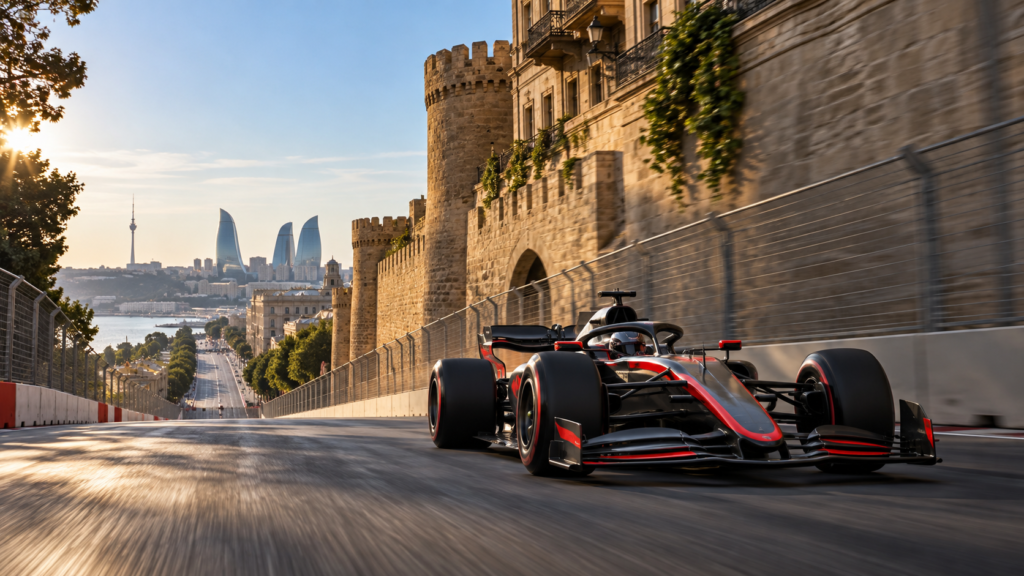
The 6.003-kilometre Baku City Circuit combines 20 corners with a 2.2-kilometre flat-out run toward Turn 1. Cars need low drag for the enormous straight, yet drivers still require enough downforce and mechanical grip to survive the slow Old Town section. At its narrowest point near the castle, the track is only 7.6 metres wide. A small mistake can block the circuit, trigger a red flag and completely reset the competitive order.
Tire degradation is usually less important than tire temperature. Drivers must keep the rubber in its operating window through long straights and low-speed corners, then trust it under some of the heaviest braking of the season. Baku’s walls punish hesitation, while the powerful slipstream makes track position fragile even after a strong qualifying performance. Strategy teams must remain flexible because a late safety car can transform a routine one-stop race into a sprint to the flag.
Weather and weekend schedule
Current forecasts point to dry conditions across the weekend, but wind could become a major factor. The official Formula 1 Azerbaijan Grand Prix page provides the latest session details. Baku is exposed to strong gusts from the Caspian Sea, especially along the pit straight and through the castle section. A shifting crosswind can alter braking points from lap to lap and make the rear of the car unstable just as drivers commit to the narrowest corners.
- Practice: Thursday, September 24
- Qualifying: Friday, September 25
- Race: Saturday, September 26 at 15:00 local time
- Distance: 51 laps of the 6.003-kilometre Baku City Circuit
Drivers and teams to watch
This 2026 Azerbaijan Grand Prix preview puts Antonelli at the top of the watch list on recent form, but Russell needs to begin reducing the championship gap immediately. Ferrari’s straight-line performance makes Hamilton and Leclerc credible threats, particularly if either can qualify on the front row. Norris will look to restore McLaren’s summer momentum, while Verstappen offers the strongest wildcard after winning the 2025 race from pole position.
For more championship coverage, visit Mr DCT’s Formula One archive. The midfield could be just as volatile. Williams brings an upgrade package into a tight constructors’ fight, and every point matters as Racing Bulls and Alpine battle for position. Liam Lawson continues to deputize for the injured Isack Hadjar at Red Bull, adding another variable to a weekend where confidence and clean running are essential.
Baku City Circuit sector guide
The opening sector looks simple on a track map, but it places immediate pressure on braking stability. Turn 1 comes after the longest sustained full-throttle section of the lap, and drivers approach with cool front tires after spending so much time in a straight line. The first three corners are all 90-degree left-handers, encouraging teams to chase traction and confidence under braking. A car that locks its inside front or struggles to rotate will lose time repeatedly, while a strong front end can create an advantage before the lap reaches the Old Town.
The middle sector is where Baku becomes unique. Turns 8 through 12 wind around the castle walls, with almost no margin between the racing line and the barriers. Drivers must attack the curbs carefully because a small bounce can push the car into the wall. The sequence is too slow for aerodynamics to rescue a poorly balanced chassis, so mechanical grip and predictable power delivery become crucial. This section also exposes a driver’s confidence: hesitation costs lap time, but excess commitment can end qualifying instantly.
The final sector is less about corners and more about exit speed. After Turn 16, the circuit effectively becomes a flat-out blast toward the finish line. Any mistake at the last meaningful corner is magnified for more than two kilometres. Teams therefore face an awkward setup compromise. Trimming the wings improves speed and defense on the straight, while additional downforce makes the car more secure through the castle section and under braking. The fastest package will be the one that loses the least in either direction.
Team-by-team outlook
Mercedes enters as the benchmark. Its 2026 car has combined efficient straight-line speed with the stable braking platform required at Baku, and Antonelli’s recent run shows how effectively the team is converting pace into victories. Russell has been consistently close enough to capitalize on any problem for his teammate, but he needs more than damage limitation if he wants to keep the championship alive. A clean qualifying session and control of the opening stint are essential for both drivers.
Ferrari may have its best opportunity in several races to challenge on pure performance. Hamilton’s ability to manage braking phases and Leclerc’s record of exceptional street-circuit qualifying laps make the pairing dangerous. Ferrari must avoid the strategic hesitation that can be costly when safety-car windows open suddenly. Starting near the front would allow both cars to use the tow, split strategies and pressure Mercedes into reacting.
McLaren’s chances depend on how quickly the car switches on its tires. Norris has shown winning pace this season, but Baku can punish a car that takes too long to build front-tire temperature. Oscar Piastri also has the precision needed for the castle section, and McLaren could become a greater threat as the track grips up. If the team qualifies on the second or third row, its race pace and tire management should keep both drivers in the podium conversation.
Red Bull arrives with less championship pressure than in recent seasons, which could encourage an aggressive approach. Verstappen can exploit a car with a lively rear end better than most, and his 2025 Baku victory provides a useful reference. The question is whether Red Bull can generate enough straight-line efficiency to attack without compromising the technical middle sector. A tow in qualifying and a well-timed safety car could bring the team into contention even if its baseline pace trails Mercedes.
Likely race strategies
A conventional dry race should favor a one-stop strategy, but Baku rarely stays conventional for long. The relatively gentle asphalt allows teams to extend the opening stint, creating flexibility around a possible safety car. Starting on the medium tire offers the broadest window, while the hard can protect track position for drivers willing to accept a slower opening phase. The soft tire is more likely to become a late-race weapon after a neutralization than a preferred starting compound.
Pit-lane timing is especially important because a safety car can make a stop dramatically cheaper. Teams at the front may delay their first stop to preserve that opportunity, but waiting too long risks losing position to an undercut. Traffic complicates the calculation: even a faster car can become trapped behind a rival that is difficult to pass in the castle section. Engineers will monitor gaps rather than tire life alone, searching for a clean window before committing.
Energy deployment will also shape the final laps. Drivers need enough battery power to defend on the main straight, yet spending too aggressively can leave them exposed one lap later. Teammates may work together by exchanging a tow or controlling the pace before the restart zone. If the Azerbaijan Grand Prix produces a late safety car, the winning move could be made before racing resumes, through tire choice, battery preparation and positioning in the train.
Baku’s history of surprise results
Baku has earned its reputation because the circuit invites situations that permanent tracks rarely create. Long straights keep the field close enough for overtaking, narrow sections punish mistakes, and lengthy recovery operations increase the chance of a safety car or red flag. A driver can build a comfortable lead and still face a one-lap restart with cold tires. That combination has produced unexpected podiums, dramatic retirements and strategic reversals throughout the event’s history.
The 2026 Azerbaijan Grand Prix arrives at a useful moment for the championship. Mercedes appears to have control of both title races, but Baku offers rivals a chance to interrupt that pattern before the season’s closing stretch. Ferrari, McLaren and Red Bull do not need to be faster across every lap; they need to stay close enough to capitalize when the circuit creates an opening. That possibility is what makes this weekend far less predictable than the standings suggest.
What could decide the Azerbaijan Grand Prix
Qualifying position matters in Baku, but it does not guarantee control of the race. The long run from Turn 16 to Turn 1 creates one of Formula 1’s most powerful slipstream effects, allowing a following car to erase a gap before the braking zone. Drivers who lead onto the final straight can become vulnerable without help from a teammate, while those running second may deliberately hold back their battery deployment for one decisive attack. That tactical tension often keeps the Azerbaijan Grand Prix open until the closing laps.
Brake confidence will be another separator. Turn 1 and Turn 3 demand heavy deceleration after long periods at full throttle, and the changing wind can make the braking reference difficult to judge. Locking a front tire costs valuable track position, but running too deep can end a race against the wall. Teams must also balance brake cooling against aerodynamic efficiency, because opening the ducts protects temperatures while adding drag on Baku’s enormous straight.
Finally, the timing of any safety car could reshape every strategy. An early interruption may encourage drivers to complete a long final stint, while a late neutralization would favor anyone with a fresh set of soft tires available. The leading teams will try to preserve options rather than commit too early. In this Azerbaijan Grand Prix, adaptability may be worth more than raw pace.
2026 Azerbaijan Grand Prix preview and prediction
Mercedes begins the weekend with the fastest overall package and the strongest recent record, so Antonelli is the logical pick for victory. Russell should also contend for the podium. However, the 2026 Azerbaijan Grand Prix preview cannot ignore Baku’s history of safety cars, red flags and surprise results. Ferrari’s speed on the main straight and Verstappen’s ability to extract performance on low-grip street circuits give both a realistic chance to break Mercedes’ run.
The 2026 Azerbaijan Grand Prix preview ultimately points to an eventful race rather than a straightforward one: at least one safety car, a close fight created by the slipstream, and a strategic decision in the final stint that determines the winner. If Mercedes executes cleanly, Antonelli should extend his championship lead. If the race becomes chaotic, Baku may deliver the upset the 2026 season has been waiting for.
