

The Bahrain Grand Prix Is Being Held in Malaysia. F1’s Calendar Stopped Being a Map Long Ago.
Aug
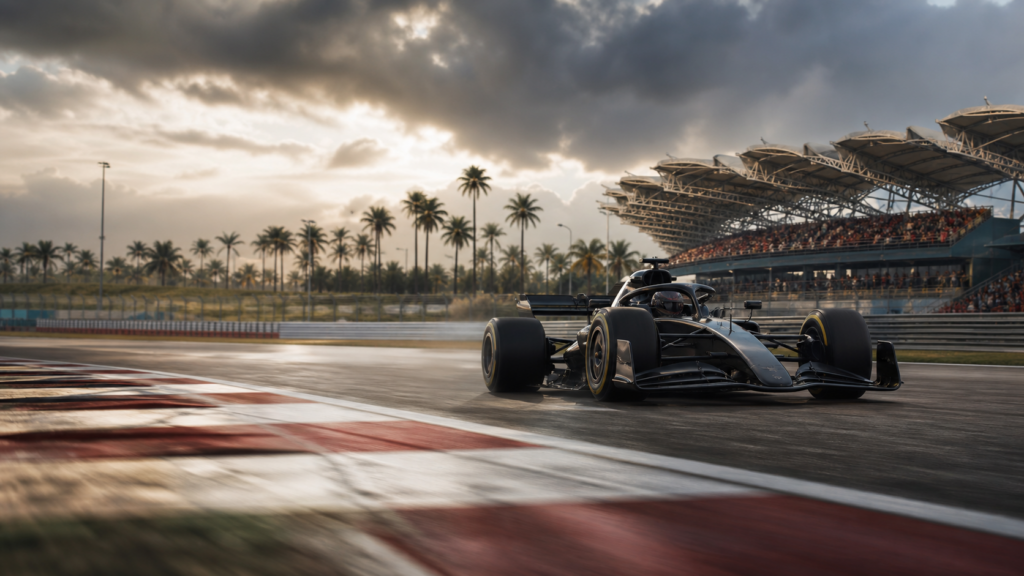
On Sunday, October 4, Formula 1 will run the Bahrain Grand Prix at the Sepang International Circuit, roughly 3,700 miles from Bahrain, in a country that no longer has a grand prix of its own. Lights out is 3 p.m. local time. The FIA published the timings on August 4 without a word of explanation, because by now none is expected.
Treat that as the tell. The 2026 calendar is not a map of where Formula 1 goes. It is a schedule of commercial rights that happen to be named after places, and this is the season the sport stopped bothering to disguise it.
How a Bahraini race ended up in Selangor
The sequence is worth getting straight. Formula 1 opened 2026 with 24 rounds. In April, the Bahrain and Saudi Arabian Grands Prix were canceled on roughly three weeks’ notice because of the US-Israel conflict with Iran, leaving a 22-race season and a month with no racing at all.
On July 26, with the Hungarian Grand Prix barely over, F1 confirmed the fix: the Bahrain Grand Prix is back, and it will be held at Sepang. The event was agreed between F1, the FIA and the governments of both Bahrain and Malaysia, and remains subject to final World Motor Sport Council sign-off. Sepang last hosted Formula 1 in 2017 — Max Verstappen’s second career win, ahead of Lewis Hamilton — before rising hosting fees and falling ticket sales ended the Malaysian Grand Prix.
So Malaysia gets its circuit back but not its race name. Bahrain keeps its race name but not its race. Sepang chief executive Azhan Shafriman Hanif confirmed the obvious practical consequence — “the race will be held in the afternoon, not at night” — and the FIA’s schedule bears it out: FP1 at 12:30 p.m. local on Friday October 2, qualifying at 4 p.m. Saturday, the grand prix at 3 p.m. Sunday. No sprint. The floodlit desert race is now a humid afternoon race in Southeast Asia, and it is still called Bahrain.
Stefano Domenicali’s statement thanked King Hamad bin Isa Al Khalifa and Sultan Ibrahim in the same breath and described the outcome as proof the sport “has demonstrated its ability to adapt, find solutions, and deliver.” That is corporate language, but it is also accurate, and it is the part of this story people are underrating.
The name is the asset
Bahrain-at-Sepang is not an isolated oddity. Look at the rest of the second half of 2026 and the pattern is everywhere.
The Spanish Grand Prix on September 13 will not be held at the Circuit de Barcelona-Catalunya. It moves to the Madring, the 5.416-kilometer, 22-corner circuit built around Madrid’s IFEMA complex — while Barcelona retains a separate round on the calendar under a city name rather than a national one. Two races in Spain; only one of them is Spain’s.
The Azerbaijan Grand Prix will be run on Saturday, September 26, at 3 p.m. local, with practice starting on Thursday. It is the first Saturday grand prix since Saudi Arabia in 2024, and the reason is that the Sunday clashes with Azerbaijan’s national remembrance day. Even the day of the week is negotiable.
None of this is scandal. It is the logical endpoint of a business where the sanctioning agreement, not the tarmac, is the thing being bought and sold. A grand prix title is an asset with a rights holder, a term and a renewal clause. Once you accept that, moving the Bahrain Grand Prix to Malaysia is no stranger than an NFL team playing a “home” game in London — and considerably less strange than pretending a race in Las Vegas is a race about Nevada.
Portability is the point
The upside here is real and it is worth naming, because it explains why F1 fought so hard for this.
Compare the World Endurance Championship. Faced with the same regional uncertainty, WEC dropped the Qatar 1812km and the 8 Hours of Bahrain outright and replaced them with Barcelona on October 18 and Monza on November 8. Two Middle East rounds became two European rounds. Formula 1, by contrast, lost two races in April and has clawed one back — a 23-round season instead of 22 — by decoupling the contract from the country.
That flexibility is not vanity. Race promotion fees are one of the sport’s largest revenue lines, and the pot that teams are paid out of shrinks every time a round disappears. A calendar that can survive a regional crisis without shedding races is a calendar that protects eleven teams’ income, not just Liberty’s. Sentimentalists should be careful what they wish for.
The cost isn’t romance. It’s the championship.
Here is where I part company with the shrug.
Kimi Antonelli leads the drivers’ standings on 219 points, 50 clear of Hamilton on 169, with George Russell a further nine back on 160 and Charles Leclerc on 138. Mercedes leads Ferrari 379-307 in the constructors’. That is a live championship going into Zandvoort on August 23, and it is going to be decided in significant part on ground nobody has current data for.
Madrid is a brand-new circuit that only Ferrari has properly sampled, via a 200-kilometer filming day on July 9 with Leclerc and Hamilton running demonstration tires on a construction site. Leclerc’s verdict on La Monumental, the 547-meter right-hander banked at 24 percent — the steepest the FIA permits, worth roughly 4G for six seconds — was that drivers will “have to be very brave.” Sepang has not seen a Formula 1 car in competition since 2017; no current setup model has been validated there. And the Azerbaijan-Sepang-Singapore triple header asks drivers to shift from European time to Malaysian afternoons and back to Singapore’s floodlit European-clock schedule across three consecutive weekends, September 26 to October 11.
Then there is the end of the season. Domenicali has confirmed Qatar and Abu Dhabi are still on the calendar as things stand, but that a decision will come “not before the middle of September,” with Imola, Portimão and Turkey all cited as fallbacks. A December title decider in the European winter is a genuine possibility. In other words, a championship separated by 50 points may be settled at a venue that has not yet been chosen.
That is the actual cost of a portable calendar, and it has nothing to do with heritage or the romance of place names. It is that competitive preparation — simulation work, tire modeling, setup baselines, the unglamorous machinery that decides modern grands prix — depends on knowing where you are going and having been there before. F1 has bought resilience with uncertainty, and it has handed the advantage to whichever team adapts fastest with the least information.
Mid-September is the date to watch. Not because the sport will finally admit the calendar is a portfolio rather than a map — it already has, in everything but the wording — but because that is when we find out whether the 2026 title is decided in Abu Dhabi in December or somewhere in Europe that nobody has printed a ticket for yet.
