WRC 2026 Title Fight: Pajari Wins, Evans Gains Ground
Aug
Filed under: Rally
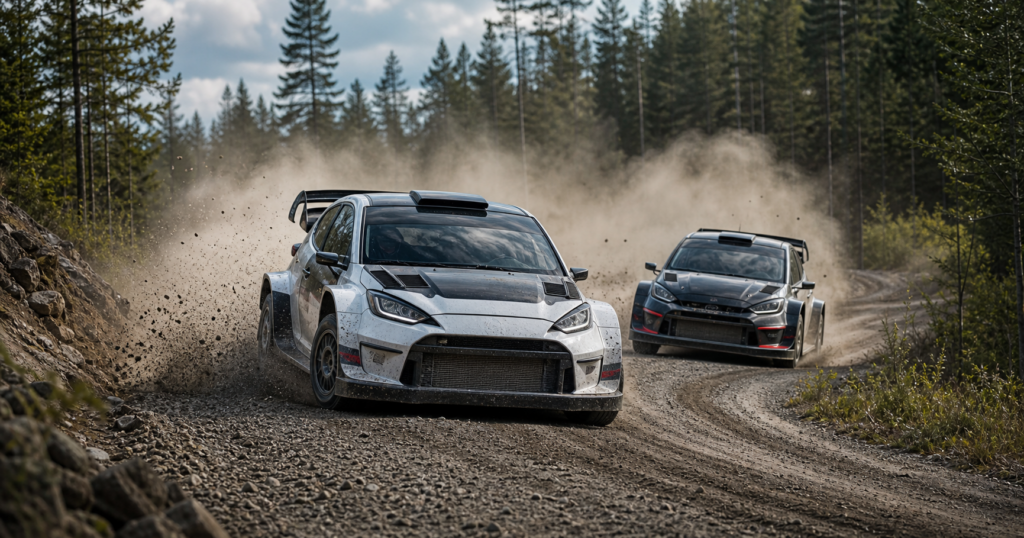
The WRC 2026 title fight barely moved in Finland. Sami Pajari and Marko Salminen won Rally Finland by 26.7 seconds, in front of a home crowd, on the 75th anniversary edition, in a car carrying the number of a driver nobody expected to be in a title fight. Elfyn Evans and Scott Martin rolled their GR Yaris three times on Saturday morning while running second overall.
Across that weekend, the WRC 2026 title gap between them in the drivers’ championship closed by three points.
After Rally Estonia, Evans led Pajari 177 to 144. After Finland, it is 201-171. Pajari won back-to-back World Rally Championship rounds — the first driver to take Estonia and Finland in the same season — and clawed back less than the value of a single stage win in the old points system. That number, not Pajari’s form, is the honest state of the WRC 2026 title contest.
WRC 2026 title points make winning barely worth more than losing
The current scoring structure is why. A rally is worth a maximum of 35 points: 25 for the overall win, up to five for topping the Super Sunday classification, up to five for the Power Stage. Pajari, led by 46.4s going into the final day, sensibly drove the two passes of the 30.02km Himos-Jämsä to the finish rather than to the clock, and left with 27 points.
Oliver Solberg and Elliott Edmondson finished 26.7s behind him and scored 26 seconds overall, plus the Super Sunday win, plus four for being 0.025s off the Power Stage. Evans, who had needed his mechanics to rebuild a car that had been on its roof, finished third and scored 24: 15 for the podium, four on Super Sunday, five for the Power Stage he won by that 0.025s.
Three drivers, three very different weekends, three points covering all of them. For the WRC 2026 title fight, this is the system rallying has chosen, and it rewards exactly one thing: being there on Sunday afternoon with a car that still steers. Pajari has been superb at that. So has Evans, and Evans has been doing it since January.
Evans keeps scoring after the result is settled
Nine of Evans’ 24 points in Finland came after the overall classification had stopped mattering to him. He was never going to catch Pajari on Sunday morning; third was secure. He went out and took second on Super Sunday and won the Power Stage by twenty-five thousandths of a second anyway.
In the WRC 2026 title race, that is not a detail. It is the mechanism by which a driver who has thrown away a rally still walks out of it having extended his championship lead — which is what happened, for the second event running. Evans’ advantage over the man in second grew at Estonia, where Pajari won, and grew again at Finland, where Pajari won.
Reverse the Power Stage — give Solberg the 0.025s — and the gap is 29 rather than 30. The difference is trivial. The habit is not.
Toyota rebuilt the championship in thirty minutes
There is an uncomfortable component to this that Toyota has been unusually open about. Akio Toyoda’s post-event note listed what the mechanics replaced on car 33 after Evans rolled it: front and rear bumpers, side panel, bonnet, tailgate, left headlight, and right-side door. Thirty minutes, no time penalty, back into the fight.
Evans’ floor this season is partly a function of a service park that can undo a three-roll accident inside a service halt. Toyota has every commercial reason to keep that floor high. Its works entry, TGR-WRT, leads the manufacturers’ championship on 514 points, ahead of Hyundai’s 340, and Pajari’s results score under the separate TGR-WRT2 banner, on 184. The driver whose points matter most to the team is the one who was upside down on Saturday morning.
None of which is a slight on Pajari. It is simply a reminder that a championship lead is built out of more than stage times, and that the thing propping up Evans is not going to stop being available to him over the last four rounds.
He has already used up the ground that suits him
The WRC 2026 title case for Pajari is real, and it is not small. Seven podiums in ten rounds is more than anyone else has managed. He has two wins, matching the best in the field. He has 171 points against 56 at the same stage last year, and since crashing twice in three days at Monte Carlo, he has not had a bad weekend. Six stage wins in Finland are not a driver being carried by circumstance.
But Estonia and Finland are his events — fast, familiar, Nordic gravel, the surface he grew up on. He has now banked both. What remains is Rally del Paraguay on 27-30 August, on red clay around Encarnación that has been on the calendar for two seasons; Rally Chile in September; and two more rounds after that, including a Saudi Arabian event whose place on the calendar Jari-Matti Latvala has publicly questioned, arguing the WRC should follow Formula 1 and the WEC in staying away this year.
On none of that ground does Pajari hold a data advantage over a driver in his ninth full season at the top level. And he has to find 30 points across four rallies in a car he cannot reliably outpace Evans in when Evans is behaving.
The threat was never the man behind
Behind them, the field has thinned out. Sébastien Ogier, who led Finland from Friday morning’s first forest stage until his heavy crash on SS17 — with Julien Ingrassia alongside him for the first time in nearly five years, standing in for Vincent Landais — is 62 points back and has said his chances are “more or less gone”, while still intending to finish the season. Takamoto Katsuta is 41 adrift and losing the consistency that got him there after hitting a tree on Finland’s final stage. Thierry Neuville, on 125, is out of it.
Evans has finished runner-up in this championship five times. What has beaten him before has never been the driver directly behind him; it has been the weekend he threw away. Finland was that weekend — the roll, the repair, the lost win — and he came out of it further ahead than he went in.
That is the shape of the WRC 2026 title fight. Pajari deserves the attention he is getting. He is also 30 points behind a man who has stopped losing championships the way he used to.
