

Jon Armstrong Has Four Rally1 Rallies Left. Driving Carefully Is the Worst Way to Spend Them.
Aug
Filed under: Rally
Jon Armstrong Rally1 analysis starts with what he told DirtFish after Rally Finland that he needs “a different strategy now for the four remaining rallies,” and that the strategy may mean “going quite carefully.” It is the reasonable thing for a rookie to say after three months without a clean Friday. It is also the worst possible use of the four rallies he has left.
Four is the exact number. The World Rally Championship calendar leaves no room to recover them later. Rally del Paraguay on 27–30 August, Rally Chile Bio Bío on 10–13 September, Rally Italia Sardegna on 1–4 October and Rally Saudi Arabia in November. All gravel. Then the Ford Puma Rally1 is finished, along with the rest of the generation, and 2027 arrives with a cheaper ruleset and a different car. Armstrong himself called Finland “likely to be the final Rally Finland for this generation of Rally1 cars.” Whatever he doesn’t take from these four events, nobody hands back.
Jon Armstrong Rally1 pace is not the problem
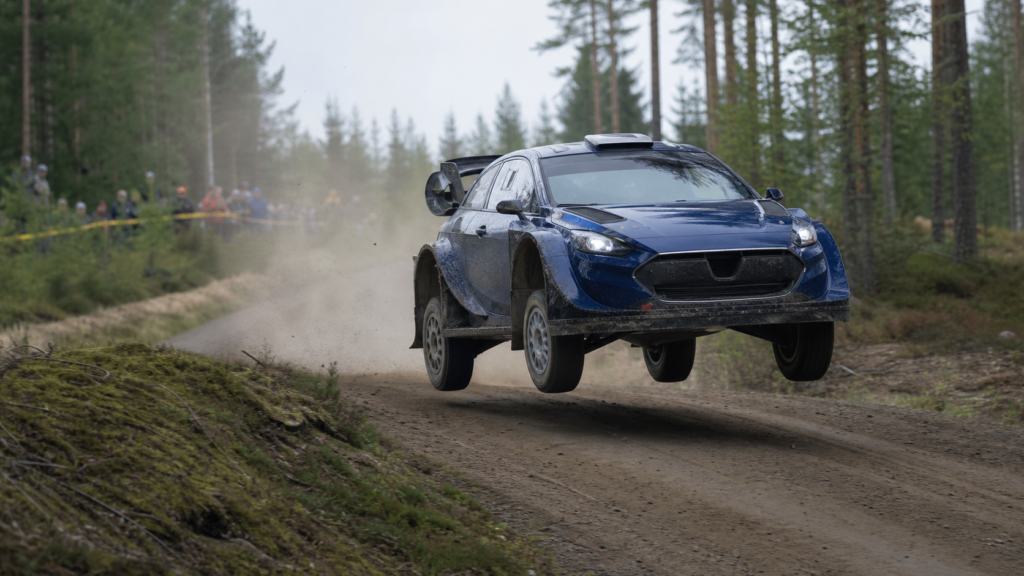
Jon Armstrong’s record since Rally Japan on 28–31 May reads badly in summary and much better in detail. At the Acropolis in June he took his maiden WRC stage win on Friday morning and then lost the day to a turbo issue and punctures — DirtFish was explicit that the Greek collapse “wasn’t down to him.” In Estonia, an awkward landing punctured a tire and dropped him out of contention, and he still recovered to ninth and two points. In Finland he clipped a bank on stage three where the road narrowed and a corner tightened more than he expected, slid into a ditch and beached the Puma. No damage to the car. No spectators close enough to push it out.
Three failure modes, one of them mechanical and one of them a completely undamaged car sitting in a Finnish ditch. That is not a Jon Armstrong Rally1 campaign defined by systematic overdriving. That is a first Rally1 season behaving the way first Rally1 seasons behave.
Finland made the point more forcefully than any argument could. Six of the 11 Rally1 crews went off the road or rolled across the 20 stages. Elfyn Evans rolled his GR Yaris on stage 14, lost 1m49s, dropped from second to fifth and still finished on the podium. Sébastien Ogier crashed heavily enough on stage 17 that the stage was canceled and he and stand-in co-driver Julien Ingrassia went to hospital for precautionary checks.
Thierry Neuville damaged the front-left of his i20 N on stage five and recovered to fifth. Mārtiņš Sesks was running as high as fifth before a high-speed roll on the same stage that caught Evans. Esapekka Lappi’s home rally ended on stage four with a damaged roll cage. If caution is the answer to Finland, half the Rally1 field should be adopting it.
The proof he wants is already in the days he’s compromised
The case for a careful Jon Armstrong Rally1 strategy is road position. Retire on Friday, and you rejoin under super rally — the regulation permitting a retired crew to restart the following day with a time penalty — which leaves you low in the classification and therefore opening the road on Saturday and probably Sunday, sweeping the loose gravel clean for everyone behind. Armstrong is right that this is a poisoned chalice. It is also, in his case, the single most persuasive piece of evidence he has produced all year.
Jon Armstrong was back out on Saturday in Finland with the road to clean, he was running inside Josh McErlean’s and Neuville’s times. On Sunday he set the sixth-fastest time on the 30km Himos-Jämsä Power Stage, the quickest of M-Sport’s three crews on the decider. He has done a version of this before: Croatia in April also ended his Friday early, and he answered it with Super Sunday and Power Stage points. A driver who can do that while sweeping does not need a clean Friday to demonstrate pace. He needs Fridays to learn what the car does when he isn’t managing anything — which is precisely what a caution strategy removes.
Grampian argues against caution, not for it
The week after Finland, Jon Armstrong and Shane Byrne won the Grampian Forest Rally in a Ford Fiesta Rally2 — the FIA candidate event for Rally Scotland — beating M-Sport team-mate Romet Jürgenson by 9.3 seconds with Lancia’s Nikolay Gryazin 39.6 seconds further back. He was second on the opening Durris stage, fastest on seven of ten, and led from stage five. A first gravel win, and a useful calibration.
Read what he said about it. Stepping out of the Rally1 car, “it felt like everything was moving in slow motion.” Competing against Rally1 drivers who are “absolutely on the limit all the time,” he said, is where “you’re learning a huge amount and putting that into practice.” That is an argument for commitment, in his own words, from the weekend immediately after the one that produced the case for caution. Both cannot be right, and the one that produced a rally win is the one worth keeping.
The points are not worth what they seem
Count what caution actually buys. Armstrong’s best days this season are eighth in Sweden, eighth and top Ford in Japan, and ninth in Estonia. In a championship where Evans leads Sami Pajari by 30 points with four rounds to run, a rookie converting a would-be retirement into eleventh place shifts nothing — not the title, not the manufacturers’ order, not M-Sport’s season. What it costs is a Friday’s worth of committed kilometers, and Finland alone carried 316 competitive kilometers.
For more on the rules change behind that calculation, read our Toyota WRC27 development analysis. The asset here was never Puma-specific setup knowledge, which expires in November regardless. It is the calibration of what a top-flight WRC Friday demands at full commitment, on the gravel of Paraguay, Chile, Sardinia and Saudi Arabia — roads Armstrong will meet again in 2027 in machinery nobody has driven yet. That transfers. Eleventh place does not.
M-Sport’s 2027 decision will not be made on Jon Armstrong’s 2026 points tally, because there aren’t enough of them to argue about in either direction. It will be made on whether the team believes he can run near the front when the car and the roads are both unfamiliar. He has four rallies to supply that evidence, and one of the two strategies available to him generates none of it.
