Toyota’s 2027 Car Is Already in Homologation Spec. Its Five Title Contenders Are Only Now Getting In.
Aug
Filed under: Rally
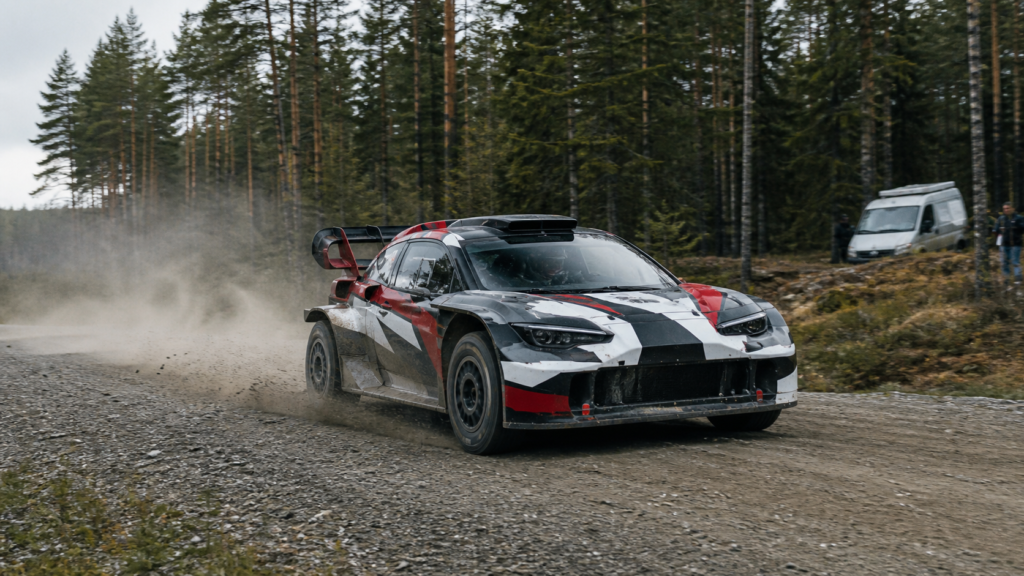
Toyota’s WRC27 car has reached full homologation specification, but Tom Fowler said three things on Wednesday that reveal a more complicated story. Only one made the headline, and it was the least interesting.
The headline was that Toyota’s active World Rally Championship drivers will increase their testing of the team’s 2027 car over the coming weeks and months. The other two matter more. Toyota’s technical director told select media, including DirtFish, that the team has completed more than 5,000km with the new car this year, and that Ott Tänak has done more of that mileage than the race drivers because “he has a bit more time on his hands.” He also confirmed the car is now in its “final evolution”, which is “in the full homologation specification that we intend to do the paperwork on with the FIA”.
Read those together, and the announcement inverts. Elfyn Evans, Sami Pajari, Takamoto Katsuta, Oliver Solberg, and Sébastien Ogier are not being brought in to shape Toyota’s 2027 car. They are being brought in to learn one that has already been shaped by a driver who has not started a world championship round this season and has no confirmed seat for next.
Five drivers, one spaceframe
Fowler’s stated principle is even-handed. “I think we’ve seen in this service park that if you develop the car for one driver then it doesn’t make a good team solution,” he said. “So I would say we need to make them all happy.”
That is the right instinct and the wrong car for it. The WRC27 regulations are built around a €345,000 cost cap, roughly 300bhp, a tubular spaceframe chassis, and Rally2 componentry. The hybrid Rally1 era brought bespoke damper programs, exotic materials, and enough development budget to build what were effectively different cars under the same skin. A cost-capped spaceframe machine sharing parts with a Rally2 does not have that latitude. There is far less room in a WRC27 car to make five drivers happy, which means the driver whose feedback arrived first is the one whose preferences are load-bearing.
Right now, on mileage alone, that is Tänak — a man who told DirtFish that a couple of test days every couple of weeks suits him better than a full season, and who has been doing exactly that since his sabbatical from full-time competition began.
The 2026 excuse has stopped working
Fowler’s explanation for the imbalance is reasonable on its face: Toyota’s Rally1 drivers “have been focusing very clearly on the goal of becoming world champion this season”. In May, that was watertight. In August, it is threadbare.
After Rally Finland, Toyota Gazoo Racing World Rally Team leads the manufacturers’ championship on 514 points to Hyundai’s 340, with TGR-WRT2 on 184 and M-Sport Ford on 130. A 174-point cushion with four rounds left — Paraguay on 27-30 August, Chile, Sardinia, and Saudi Arabia in November — is not a title fight. Hyundai has no realistic route back.
The drivers’ championship is live, but it is entirely internal. Evans leads on 201 points from Pajari on 171, Katsuta on 160, Solberg on 156, and Ogier on 139. Adrien Fourmaux, the best-placed non-Toyota driver, is 72 points off the lead on 129. Toyota wins this championship no matter which of its five cars crosses the line first in Saudi Arabia. What the team is protecting by keeping those five out of the 2027 car is not a championship. It is a decision about which of its own drivers gets to keep the trophy.
Set against that, the 2027 Rallye Monte-Carlo — penciled in by the Automobile Club de Monaco for 18-24 January, subject to World Motor Sport Council approval — is a little over five months away, with an all-new technical ruleset and a car whose homologation paperwork is imminent.
Toyota isn’t just building its own car
This would be a Toyota problem if Toyota were one of four manufacturers building to the new rules. It isn’t. Cyril Abiteboul has ruled out Hyundai developing an all-new 2027 challenger, telling Autosport that an upgraded Rally2 i20 N is the only route open — “with a new spec technical regulation, this train is probably gone”. M-Sport is reported to be leaning the same way with a Rally2 Ford. The genuinely new WRC27 cars are coming from tuner-constructors: Project Rally One, founded by Lionel Hansen, Yves Matton, and Prospeed, and Spain’s RMC Motorsport, with Project Rally One’s first car only now reaching its maiden test.
That makes Toyota’s WRC27 car the reference point. The FIA has been explicit that it will not run a Balance of Performance system — technical director Xavier Mestelen Pinon said last autumn that “if we start to talk about Balance of Performance, it will kill our championship” — and that the single lever for equalizing WRC27 machinery against Rally2 will be minimum weight, set before the season rather than adjusted during it. That calibration will be run against a benchmark car that Toyota’s own race drivers have barely driven.
Fowler set the price himself
The part of this that should make Toyota uncomfortable is that it created the incentive deliberately. Asked in May whether Tänak would race for the team in 2027, Fowler said the first question was whether Tänak even wants to compete, and that the answer “will depend on how good job he does on developing the car… he needs to get his skates on!” He also conceded that finding a slot is “getting more difficult because more of the junior-end drivers have stepped up their game quite a lot already this season.”
So Toyota handed a driver with no seat the job of defining the car, and made his seat conditional on how well he did it. There is only one rational way to respond to that brief, and Tänak — who Fowler has praised, in blunter language than this, for his refusal to soften bad news — is not a man who does things by halves. If he has done the job Fowler asked for, he has spent 5,000km building a car he would want to race, and Toyota will have to find room for him. If he hasn’t, Toyota arrives at Monte Carlo with a homologated car that none of its five race drivers put their name to.
The honest counterpoint is that homologation specification is not a frozen setup. Dampers, geometry, differentials, and whatever aerodynamic freedom the box allows all remain live, and a spaceframe car with Rally2 parts iterates faster than a hybrid Rally1 ever did. Bringing in four more voices now is precisely how you correct for a car designed around one driver. But that correction has a deadline, and the deadline is the FIA paperwork, not the start line in Monaco.
Toyota has spent 2026 letting five drivers fight over a championship it was always going to win, while one driver on sabbatical quietly wrote the specification all five will have to race next January. Whichever of them ends the season with the number one on the door, that is the more consequential result of Toyota’s year.
